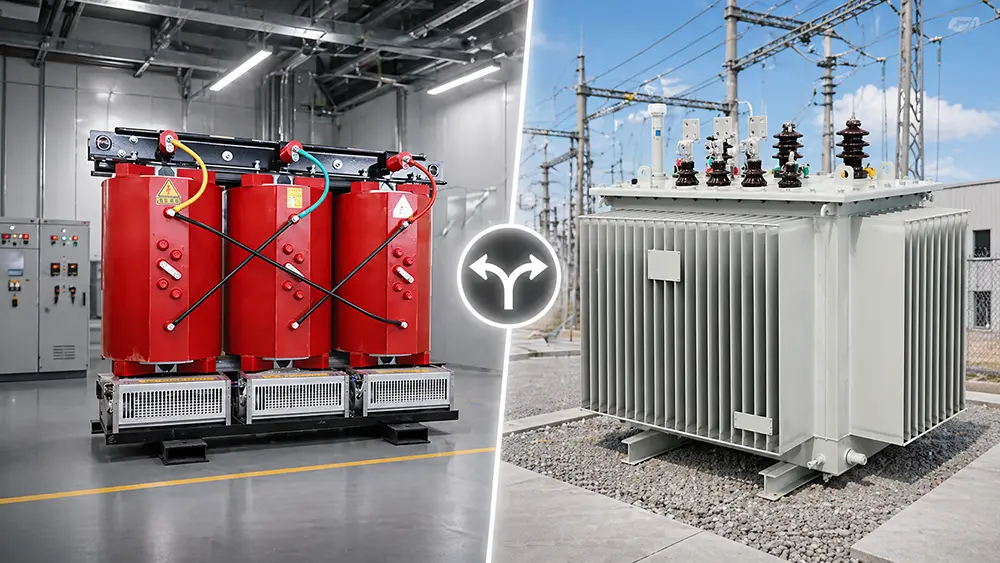
Dry-Type or Oil-Immersed Transformer? A Decision Framework for Industrial Projects
One of the most common questions in industrial RFQs is direct: should we choose a dry-type transformer or an oil-immersed transformer?
The shortest honest answer is: it depends on the site, the risk profile, and the way the plant team will operate the asset over time.
In real projects, this choice is rarely about product preference alone. It sits at the intersection of safety policy, installation environment, maintenance resources, and commercial priorities.
Start from project context, not from habit
A new electronics facility once asked us to quote only oil-immersed units because that was their historical standard. During layout workshops, however, the transformer location moved closer to occupied indoor areas and cable routes became constrained.
At that point, the decision criteria changed. Fire-safety procedures, space management, and maintenance access became more important than initial equipment familiarity.
After joint review with the EPC and plant team, the customer selected a dry-type transformer configuration for the indoor zone and retained oil-immersed equipment for the outdoor utility expansion phase.
The mixed strategy aligned better with real operating conditions than a single-technology rule.
When dry-type transformers are often preferred
A dry-type transformer is frequently a strong option when:
- Installation is indoors or near high personnel density.
- Fire and environmental handling requirements are strict.
- Maintenance teams prefer simplified routine inspection paths.
- Load points are distributed and closer transformer placement reduces cable complexity.
In these scenarios, dry-type solutions can support safer integration with building operations and simplify day-to-day management.
When oil-immersed transformers often make sense
An oil-immersed transformer is often favored when:
- Higher-capacity demand requires strong thermal performance.
- Installation is outdoors with suitable civil and safety arrangements.
- Lifecycle economics prioritize lower cost per kVA at scale.
- The site has established oil management and inspection capability.
For many heavy industrial project environments, this remains a robust and economical path when properly engineered and maintained.
The hidden factor: operational discipline
Across many projects, the final performance gap is not created only by transformer type. It is created by operational discipline after commissioning.
For example:
- Are inspection routines standardized and documented?
- Are alarm thresholds meaningful and linked to action?
- Is there clear ownership for trend analysis and escalation?
- Can the site coordinate quickly with the transformer supplier when conditions change?
A well-managed oil-immersed fleet can outperform a poorly managed dry-type fleet, and vice versa. Technology choice matters, but execution matters more.
A practical scoring model for B2B project teams
For procurement and engineering teams, we recommend a simple weighted scoring discussion across five dimensions:
- Safety and compliance fit
- Installation and space constraints
- Thermal and load behavior requirements
- Maintenance capability and spare strategy
- Total lifecycle cost and expansion flexibility
This structure helps stakeholders move from opinion-based debate to evidence-based decision-making.
What a capable transformer supplier should contribute
In this selection process, a strong transformer supplier should do more than send two datasheets. They should help the customer clarify assumptions, compare trade-offs transparently, and translate site constraints into an implementable custom transformer solution.
For a transformer for factory or large industrial power distribution project, useful supplier support usually includes:
- Early coordination with EPC and electrical consultants.
- Clear boundary definition for accessories and interface responsibilities.
- Commissioning guidance and startup checklists.
- Post-energization follow-up and service response pathways.
This is where technical competence and communication competence meet.
Choosing confidence over simplification
There is no universal winner between dry-type and oil-immersed designs. The better choice is the one that fits your project reality, your team’s operating style, and your future expansion path.
When buyers and suppliers evaluate that reality together—openly, carefully, and with long-term service in mind—the transformer decision becomes less risky, and the project outcome becomes more predictable.
That predictability is what industrial buyers are really purchasing.
