Transformer Pre-Energization Checklist Before Startup
A transformer should not be energized just because it arrived on site, passed factory testing, and is now bolted to its foundation. The short answer is: before first energization, the site team should align mechanical completion, nameplate and document traceability, grounding, cable or bus connections, insulation and oil or dry-type condition checks, switchgear readiness, protection settings, control wiring, permits, and utility or AHJ release.
This article is for buyers, EPC teams, plant engineers, and project managers who need a practical pre-energization checklist for transformers and associated switchgear. It helps a procurement team ask better questions and collect evidence, but it does not replace the final decision of a registered electrical engineer, commissioning authority, utility reviewer, protection specialist, local AHJ, or qualified site testing team.
Pre-energization is a site hold point
Factory acceptance testing and site energization answer different questions. FAT asks whether the manufactured transformer package matches the approved order before it leaves the factory. Receiving inspection asks whether the transformer arrived in acceptable visible condition and was stored properly before installation. Pre-energization asks whether the installed system is ready to be connected to live power under the project design.
Those stages should connect. The approved datasheet, drawings, wiring diagram, test report, packing list, accessory schedule, and open-deviation log reviewed during the transformer FAT checklist should still match the equipment now installed on site. The visible condition, accessory control, moisture concerns, and temporary preservation records from the receiving inspection and storage checklist should also be closed before startup.
The practical goal is not to create paperwork for its own sake. It is to prevent a common failure mode: the transformer, cables, switchgear, protection settings, auxiliary power, grounding, and site approvals are each treated as separate tasks, but nobody confirms that they are ready as one electrical system.
Site checklist before first energization
Use this table as a coordination tool. The final test methods, acceptance criteria, values, and sign-off authority must come from the project specification, supplier manuals, applicable standards, local code, utility requirements, AHJ review, and qualified engineering judgment.
| Checkpoint | What the buyer or site team should ask | Evidence to collect before release |
|---|---|---|
| Equipment identity | Does the installed transformer match the purchase order, nameplate, approved datasheet, latest drawings, and serial-numbered factory test report? | Nameplate photos, final datasheet, drawing revision, test report, and deviation closeout record. |
| Mechanical installation | Are foundation, level, anchoring, wheels, anti-vibration details if specified, access clearance, ventilation path, and lifting or removal route consistent with approved drawings? | Installation photos, civil handover record, layout drawing, and unresolved punch-list items. |
| Grounding and bonding | Are tank or enclosure earthing points, neutral grounding arrangement, switchgear earth bar, cable shields, surge protective devices, and bonding conductors installed according to the project design? | Grounding drawing, continuity or resistance records where required, inspection sign-off, and local authority requirements. |
| Cable or bus interface | Are cable terminations, lugs, glands, stress-control parts, bending radius, phase identification, torque records, busduct interface, and clearances checked by qualified personnel? | Termination inspection record, torque or assembly record where required, cable test report, and marked photos. |
| Oil-immersed condition | For an oil-filled unit, have oil level, valves, breather or sealing arrangement, radiator position, gauges, leaks, accessories, and oil or insulation tests required by the project been reviewed? | Supplier manual checklist, oil handling record if applicable, field test report, accessory checks, and leak inspection notes. |
| Dry-type condition | For a dry-type unit, are coils, insulation surfaces, enclosure airflow, space heaters if specified, temperature sensors, fans if supplied, dust, moisture, and room ventilation ready for service? | Visual inspection record, insulation test report where required, ventilation confirmation, and control circuit checks. |
| Accessories and control wiring | Are temperature devices, alarm and trip contacts, heaters, fans, marshalling terminals, CTs if supplied, and auxiliary circuits wired to the correct terminal numbers? | Wiring continuity record, terminal list, functional test notes, and control power confirmation. |
| Switchgear status | Are incoming and outgoing switchgear panels installed, tested, interlocked, labeled, cleaned, closed up, and placed in the required operating position for the energization plan? | Switchgear commissioning report, interlock test record, panel inspection, and switching procedure. |
| Protection and metering | Are relay settings, CT ratios and polarity, trip circuits, metering circuits, communication points, alarms, and protection coordination approved for the actual transformer and system fault study? | Approved setting files, relay test report, trip test evidence, latest single-line diagram, and engineering approval. |
| Authorization to energize | Has the site completed lockout control, safety briefing, permit-to-work closeout, utility approval, AHJ release where required, and a named energization procedure? | Signed pre-energization certificate, permit closeout, utility or AHJ correspondence, and switching order. |
No single row proves readiness by itself. The release decision depends on the complete installed system and the authority defined by the project.
The transformer and switchgear must be checked together
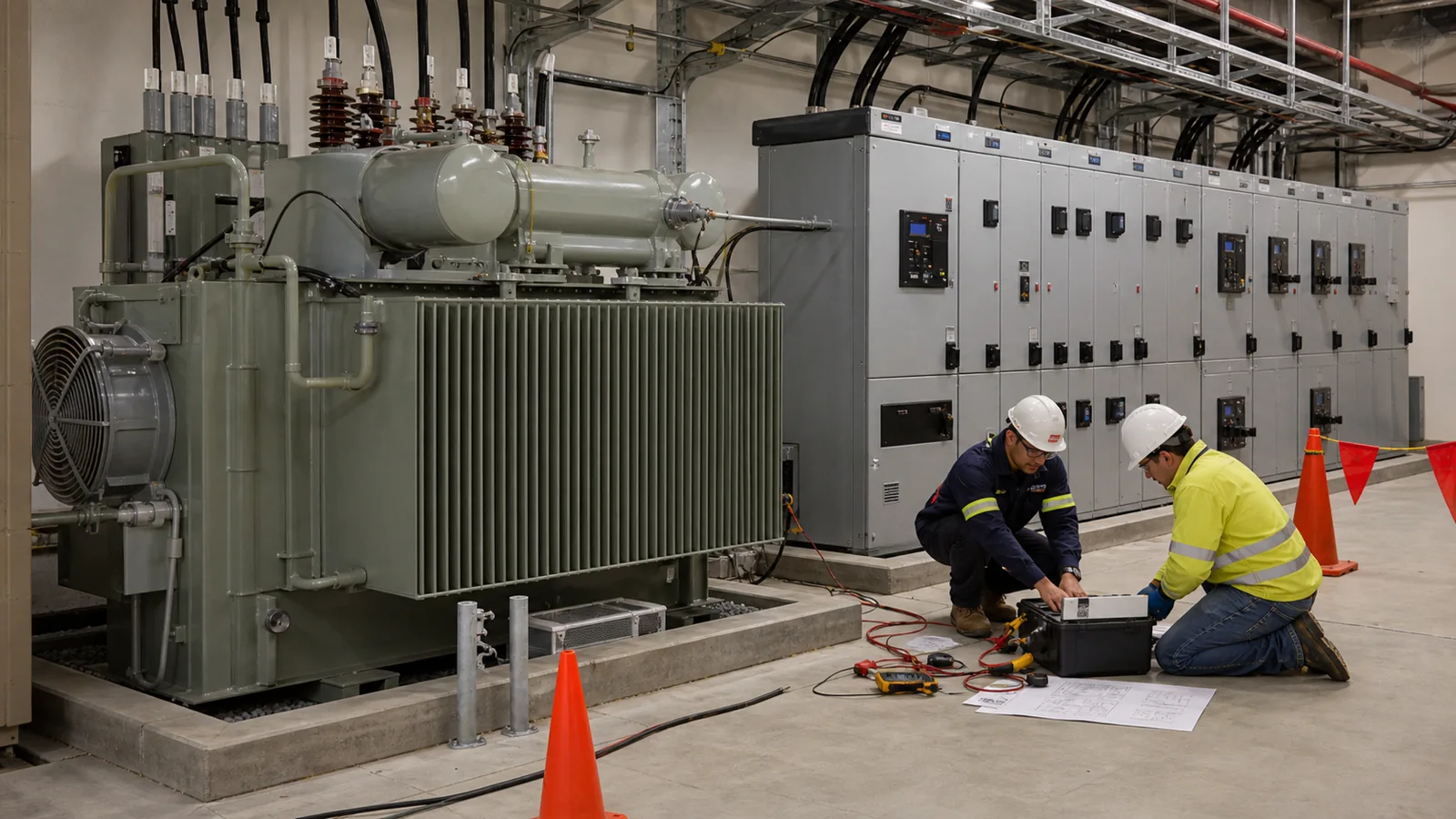
Many startup problems appear at the boundary between the transformer and the switchgear. The transformer may have correct rated voltage, vector group, impedance, and accessories, while the switchgear still has an unfinished cable compartment, a missing control fuse, a protection relay loaded with a preliminary setting file, or an interlock not tested under the final operating sequence.
For projects that include switchgear, the pre-energization package should connect the transformer documents to the switchgear documents. The latest single-line diagram, fault study, protection coordination, relay settings, CT data, metering requirements, auxiliary supply, and earthing design should tell the same story. If the transformer was purchased separately from the panels, this check becomes more important because each supplier may assume another party owns the interface.
Buyers should be careful with phrases such as “standard protection” or “ready for energization.” They are not acceptance criteria. Ask who verifies the settings, who performs injection or functional tests if required, who authorizes the switching order, and who signs the final release.
Oil-immersed and dry-type checks are not identical
An oil-immersed transformer usually requires attention to liquid-filled equipment details: oil level, valve positions, pressure or sealing arrangement, breather condition where applicable, radiator and cooling accessory status, leak inspection, oil containment, fire separation, and oil or insulation tests required by the project. Final checks should follow the supplier manual and the applicable standard basis.
A dry-type transformer shifts the focus toward coil condition, dust or moisture, enclosure ventilation, room temperature assumptions, space heaters, temperature sensors, fan control if supplied, cable-box cleanliness, and building fire or access rules. Dry-type equipment avoids insulating liquid, but it is still sensitive to installation environment and ventilation. A dry-type unit should not be treated as maintenance-free during commissioning.
In both cases, never assume that factory test results automatically cover cable installation, site grounding, protection settings, room ventilation, or utility release. Those are site-system checks.
Standards help define scope, not shortcuts
Useful standards and guides can help a project team name the right checks. For example, IEEE C57.93-2019 addresses installation and maintenance guidance for liquid-immersed power transformers in the IEEE context. ANSI/NETA ECS describes electrical commissioning specifications for electrical power equipment and systems. IEC 60076-1 is a common general reference for IEC power-transformer practice.
Those references are not interchangeable global permission to energize. The applicable market, project specification, utility rules, local electrical code, fire requirements, seismic or environmental rules, AHJ process, and supplier documentation decide the final requirements. If a buyer exports or imports equipment across markets, the RFQ and commissioning plan should state the intended standard basis instead of assuming that IEC, IEEE, ANSI, NEMA, GB/GB/T, DOE, EU, or utility language means the same thing.
RFQ wording buyers can add before purchase
Pre-energization quality starts before the order. Buyers can add clauses like these to the transformer or switchgear RFQ:
“Supplier shall provide the final datasheet, outline drawing, wiring diagram, terminal list, accessory schedule, nameplate data, factory test report, installation manual, storage instructions, and commissioning-related precautions for the exact unit supplied.”
“Quotation shall identify which site tests, protection settings, utility approvals, cable tests, grounding checks, oil or insulation checks, switchgear commissioning items, and energization permits are excluded from supplier scope and must be handled by the EPC, owner, testing contractor, or local authority.”
“Factory test reports do not replace site acceptance testing, protection coordination review, grounding verification, cable termination inspection, switchgear interlock testing, or energization approval by qualified personnel.”
“Final energization shall be subject to project documents, approved drawings, supplier manuals, local code, utility requirements, AHJ review where applicable, and a signed site release procedure.”
A practical release rule
Do not energize because the transformer is installed. Energize only after the installed transformer, connected cables or buswork, switchgear, grounding, protection settings, auxiliary circuits, documents, permits, and responsible sign-offs agree with the approved project basis.
That rule gives buyers a better way to manage risk without pretending to be the commissioning engineer. It also gives suppliers, EPC teams, testing contractors, and site operators a shared checklist for closing the last gaps before the first switching operation.
