
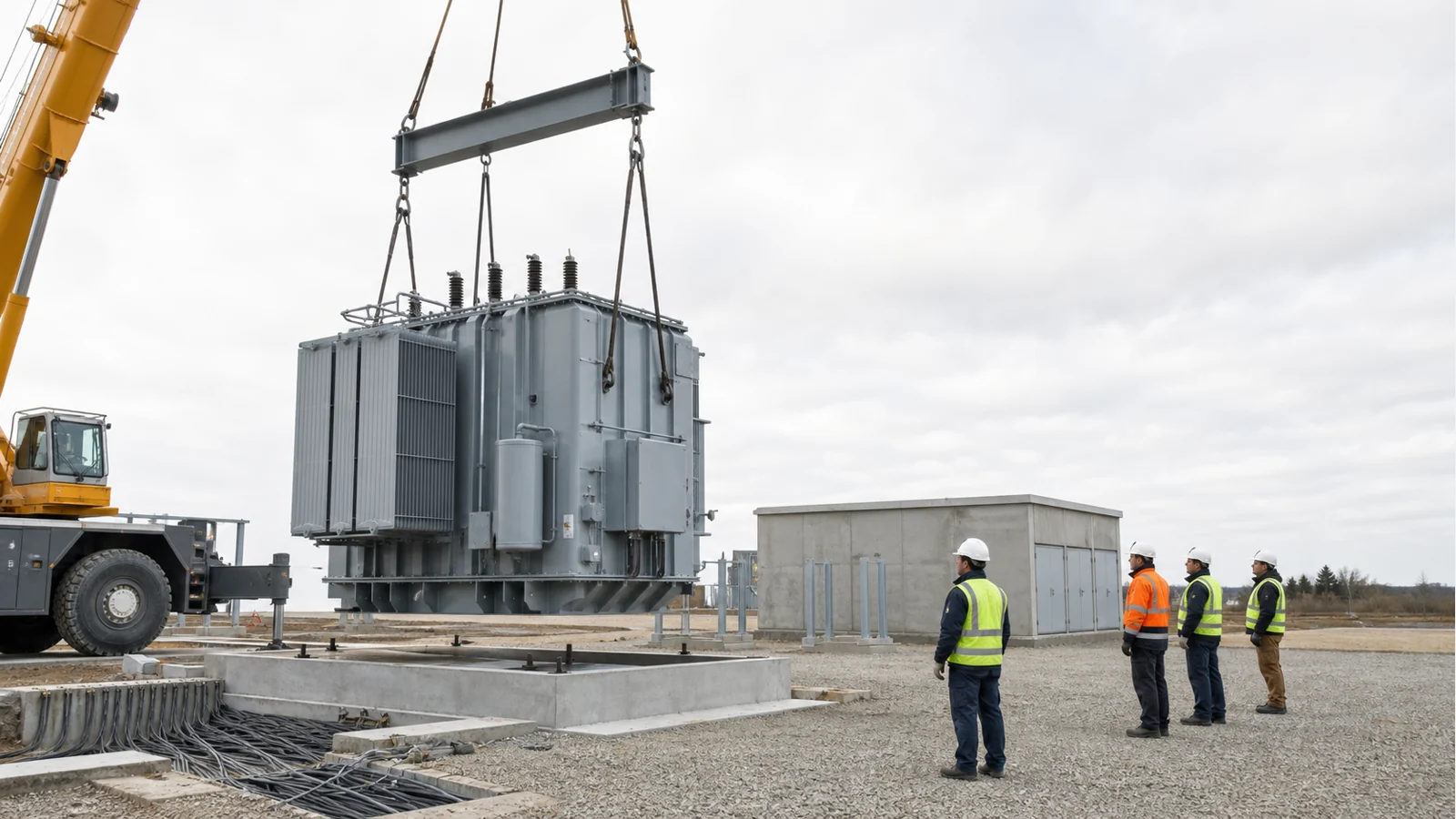
Transformer Lifting Plan: RFQ Checks Before Delivery
A transformer can be electrically right and still miss its installation date because the lifting plan started after the equipment left the factory. The truck route may not accept the shipment envelope. The foundation may be ready but inaccessible to the crane. The site may expect the supplier to provide lifting accessories that are not in the quoted scope.
The practical answer is to make lifting and delivery interfaces a purchase-stage check. Before shipment release, the buyer should have the final shipping mass and dimensions, centre-of-gravity information if provided, approved lifting-point arrangement, transport configuration, lifting instructions, site route constraints, foundation readiness, crane and rigging responsibility split, and a named person to close open points. The final lift plan must be prepared and approved by competent, qualified personnel under the project method statement, equipment manuals, local law, site rules, and the applicable authority’s requirements. This article helps buyers ask the right questions; it is not a crane plan, rigging design, or authorization to lift equipment.
A delivery problem is usually an interface problem
Procurement teams often receive a shipping weight late in the process, then pass it to logistics. That is useful, but it is only one input. A lifting contractor needs the real lift configuration, not only the transformer nameplate rating. The contractor may need the final outline drawing, shipping drawing, marked lifting points, removable-item list, packing arrangement, anticipated radius and elevation, ground and outrigger conditions, overhead restrictions, exclusion-zone arrangements, and the manufacturer’s handling instructions.
The electrical and civil teams also need the same information. A transformer that arrives with radiators, bushings, cable boxes, conservator parts, or accessories packed separately may have a different delivery envelope and a different site assembly sequence from the fully assembled outline drawing. Conversely, removing parts for transport can change what must be fitted, inspected, or tested before energization.
Use the following schedule as an RFQ and shipment-release matrix. It does not replace the site lift plan.
| Item to close | What to request or confirm | Why it matters |
|---|---|---|
| Transport and installed mass | Ask for the shipping mass, installed mass where relevant, loose-part masses, and the document revision that controls each figure. | Crane, trailer, foundation, and handling decisions can be wrong when they use a catalogue estimate or a nameplate value instead of the final shipment data. |
| Dimensions and transport configuration | Request the final outline and shipping drawings, including packed dimensions, protrusions, removable components, and any transport braces. | A unit may clear a foundation but not a gate, turn, bridge, door, cable trench crossing, or indoor handling route. |
| Lifting points and method | Request the manufacturer’s lifting instructions, approved lifting points, stated restrictions, and any required spreader beam or special attachment. | Do not assume that a convenient bracket, radiator, bushing support, or cable box can be used as a lifting point. |
| Centre of gravity and stability | Ask whether centre-of-gravity data, tilt limitations, or special transport and lifting conditions are supplied for the quoted configuration. | The lifting contractor needs the final equipment information to select a safe arrangement under the project rules. |
| Site route and set-down area | Provide the route survey, access widths and heights, turns, slope, ground condition, overhead lines or structures, and the available laydown area. | Transport and crane access can be constrained by site conditions that do not appear on electrical drawings. |
| Foundation and interfaces | Confirm foundation release, anchor pattern, elevation, embedded items, oil containment, cable trench protection, earthing interface, and installation clearances. | A completed lift cannot compensate for a foundation or interface that is not ready to receive the transformer. |
| Scope split | State who supplies the crane, rigging, spreader beam, lifting supervision, traffic control, temporary supports, assembly labor, and protection of exposed cable trenches. | A vague “delivery included” line can leave a critical site activity without an owner. |
| Evidence before release | Request final drawings, packing list, handling manual, accessory list, shipping photos where agreed, deviation record, and serial-number traceability. | The receiving and installation teams need a common record of what was shipped and how it should be handled. |
Start with the final shipping configuration
Ask the manufacturer to distinguish the transformer as shipped from the transformer after site assembly. For an oil-immersed transformer, transport limitations can affect whether some accessories are fitted, removed, protected, or shipped separately. For a dry-type transformer, enclosure sections, rollers, cable boxes, and protective packing may change the handling sequence. For a packaged compact substation, transformer, enclosure, medium-voltage equipment, low-voltage equipment, and loose accessories may arrive as separate lifting packages.
The buyer should request current, controlled drawings rather than reuse dimensions from an early quotation. The final documents should show the relevant configuration and clearly identify any optional equipment actually included in the order. If the final shipment differs from the approved layout, flag that before logistics bookings and site mobilization are fixed.
This is also the right time to join lifting data to the civil review. The foundation and mounting RFQ checklist covers interfaces that should be aligned with the final outline drawing. It does not determine crane capacity, soil bearing, lifting radius, or rigging selection; those remain project-specific checks for the appointed lift and civil specialists.
Make the scope boundary explicit
“Delivered to site” does not always mean “set on foundation.” It may mean delivery to a port, gate, site laydown area, or a point accessible to a normal vehicle. The purchase order should say which interpretation applies and who controls the work after that handover point.
Useful questions include:
- Is the transformer delivered on its base, on a transport frame, or with temporary supports that must be removed on site?
- Does the manufacturer supply only designated lifting information, or also a special lifting beam or attachment? If an accessory is supplied, what is its documentation and return arrangement?
- Who verifies the final equipment mass against the lifting contractor’s plan after drawings are released?
- Who protects nearby live equipment, cable trenches, containment walls, finished pavement, and the foundation during the lift?
- Is site assembly of loose radiators, bushings, cable boxes, controls, or enclosure parts in supplier scope, EPC scope, or another contractor’s scope?
The answers should be recorded in the purchase order, responsibility matrix, and approved method statement. They should not be inferred from a product photograph or a generic delivery term.
Safety references are not a global lift specification
Where United States OSHA rules apply, 29 CFR 1926.251 requires inspection of rigging equipment and identifies manufacturer-marked working-load information as a key control. OSHA’s wire-rope sling guidance also notes that sling angle and condition matter. These are useful reminders for a procurement checklist, not a universal crane or rigging rule.
The governing lifting requirements may instead come from the country of installation, port rules, client standards, construction regulations, crane owner’s procedures, local authority, utility rules, or the project’s HSE plan. Do not convert an OSHA, ASME, ISO, EN, IEC, IEEE, GB/GB/T, ANSI, NEMA, utility, or local reference into a worldwide default. The lift supervisor and responsible project team must verify the applicable requirements and the specific equipment configuration.
Link shipment release to receiving and energization
Lifting data should be in the release package, not buried in an email. The factory acceptance and shipment checklist can be used to align final drawings, packing, accessories, and test evidence before dispatch. At arrival, the site team should compare the delivered package and visible condition against that file using the receiving inspection and temporary storage checklist.
After placement, a separate installation and commissioning review is still needed. Mechanical placement alone does not prove electrical readiness. Grounding, protection settings, cable work, oil or insulation checks where applicable, accessory wiring, interlocks, site tests, and energization authorization all remain subject to the approved project procedure and qualified personnel. The pre-energization checklist is a useful handover reference, but it does not replace the project commissioning plan.
RFQ wording buyers can adapt
Please provide final shipping and installed masses, shipping and installed outline drawings, packed dimensions, approved lifting-point arrangement, handling and lifting instructions, loose-part list, and any centre-of-gravity or transport restriction information available for the quoted configuration. Identify all items removed or separately packed for transport.
Delivery and placement scope is [state agreed point]. Please identify whether craneage, rigging, special lifting devices, lifting supervision, traffic control, temporary supports, site assembly, and protection of site interfaces are included or excluded. Final lifting and installation arrangements are subject to the approved project method statement, manufacturer instructions, local requirements, and competent-person review.
Do not release shipment until the final drawings, packing list, handling information, accessory schedule, deviations, and serial-number references are consistent. Any change affecting shipment mass, dimensions, lifting points, transport configuration, or site assembly must be issued to the buyer and appointed contractor before dispatch.
A simple hold-point rule
Pause dispatch planning if the team has a transformer price and a requested delivery date, but no final shipping configuration or named lifting-scope owner. A short review at that point can prevent a much larger delay caused by an inaccessible route, unplanned crane mobilization, missing lifting information, or a foundation that cannot yet receive the unit.
